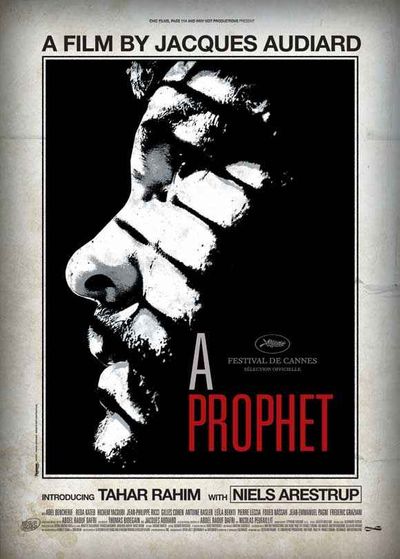
 Official movie poster
“The idea is to leave her smarter,” remarks the veteran to the newcomer. They are sitting in a concrete-walled French prison, the former unaware that the latter intends to kill him. But until he does, the duo make small talk about reading and books and learning. It’s this scene, which provides the spark that sets the plot of Jacques Audiard’s A Prophet in motion, even more so than the main character’s recruitment into the Corsican prison gang.
Malik El Djebena (Tahar Rahim) is a man caught between worlds. The Muslims in the prison where he is sentenced to spend the next six years hate him because he works for Corsicans and the Corsicans treat him as their sub-human servant for being Muslim. But instead of letting his status dictate his behavior, El Djebena takes the advice the prisoner he was ordered to kill, Reyeb (Hichem Yacoubi) and makes himself smarter. Not only book smart, but street smart as well.
His story stretches six years compressed into a two hour and 40 minute film which only sometimes feels as long as it sounds. It is the story of his journey from the wallflower boy he entered prison as into the mafia kingpin he emerges as. It’s not something you haven’t seen before–crooked prison guards, drug deals, double crossing–but it’s done in a way you wouldn’t have expected. Of course, comparisons will be made to The Godfather (it is, after all about the mafia and it’s patriarch), but more than just a story of crime and hierarchy, it elevates the protege and gives the mob boss a human side.
El Djebena arrives at the prison with no friends, no family and no connection to the outside world. Despite his attempts to keep his head down and avoid trouble, trouble finds him when the Corsicans realize they can use him to kill a man set to testify against them. Though he at first refuses, he eventually agrees for the sake of his own life. Realizing he is now under their thumb, El Djebena sets his own secret agenda in motion, refusing to become a puppet. He learns how to read, write and speak Corsican. But his greatest learning happens outside the prison school–in “godfather” Cesar Luciani’s (Niels Arestrup) prison mafia school.
The juxtaposition of Luciani and El Djebena is fascinating to watch unfold on screen. At the outset, Luciani the alpha male, a quietly intimidating presence apt to snap with the slightest provocation or insubordination and El Djebena duitifully performs the tasks given him as Luciani’s personal servant. But as the story progresses, roles are reversed as El Djebena grows cocky in his skills and knowledge, stepping further outside his boss’s orders to further his own agenda, while Luciani appears to grow more vulnerable as he is delivered blow after blow to his firm reign of his prison regime.
Even as El Djebena struggles to straddle the radically different world of the Muslims and Corsicans, he must also find a way to exist inside the prison and function outside of it on his leave days. For him as well as the audience, his initial moments outside the prison walls are a breath of fresh air. He enjoys his freedom–the sun on his face as he gazes upwards and wind on his face as he sits in the passenger seat of the car with the window rolled down. And he can breathe deeply. Amidst a film of such intense violence and grittiness, the world outside provides momentary pause before plunging back in for the second half. But these moments are short-lived, as he has orders to follow, deals to carry out and hits to execute.
The darkest part of the film by far is the haunting of El Djebena by Reyeb’s ghost. Yet aside from the intrinsic eeriness his specter, his appearance and guidance offer insights to the title of the film. As the two stand at the small enclosed window of the prison cell, Reyeb comments on the actions of each man in the yard below during rec time. The one running will turn around and start again, that one over there will stop and do push-ups and the tall one playing basketball is going to dunk it.
These scenes, presumably a fabrication of El Djebena’s over-exerted psyche, illustrate the connection between his dreams and visions and the reality they predict. And when his visions save him and his fellow traveler from a serious accident, his associate turns to him and asks him, “So are you a prophet, or what?” Quite appropriate, considering El Djebena is Muslim, and Islam is based on the teachings of the prophet Muhammad.
Strangely, prison was good to El Djebena, better than his six years would have been without them. Though pursing his own agenda comes with a cost, his network is extensive enough to put him ahead of the curve. And the fifty euros he stuffs into his shoe at the beginning of his incarceration serve only as a souvenir of who he was when he entered.
 rachel grice