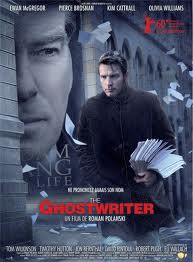
 Official movie poster
Creating a film is no easy undertaking, much less doing so while under house arrest. but in Roman Polanski’s latest film, The Ghost Writer, the director proves that, despite his personal shortcomings, he remains a talented filmmaker.
To accommodate Polanski’s unusual restrictions, all of the filming had to take place within court-designated boundaries. Thus the German island of Sylt became a substitute for Martha’s Vineyard and Berlin was transformed into London. But past the off screen legal proceedings, lies a masterful film of political intrigue and buried secrets.
Ex-British Prime Minister Adam Lang (Pierce Brosnan) and his team of publicists, speechwriters and personal advisors are forced to hire a new ghost writer (Ewan McGregor) to finish Lang’s memoirs after police find the first’s dead body washed up on shore. Was it an accidental death or was it a suicide? “Accident, suicide, who cares?” the Ghost’s agent remarks flippantly. But the Ghost’s suspicions grow as he sits in an airport bar waiting for a flight to take him to meet his new boss in the States. The lead story on the nightly news informs him that the International Criminal Court is investigating Lang for allegedly handing four terrorists over to the CIA to be interrogated and tortured.
Everything in this film is shadowy and rainy, an allusion to the murky realm of politics. Dark, muted colors fill scene after scene, only interrupted by infrequent splashes of red and yellow–a red “Fatal Incident” sign on the ferry, a yellow shopping bag containing a manuscript, violent brush strokes of red paint resembling blood on a canvas hanging in the bedroom, the red glow of the vacancy sign of a motel. It’s as if the setting itself becomes a character, mimicking the mood of the characters and the suspicions that exist between each one of them. The Ghost learns to distrust the stories Lang feeds him, even musing that there is “something odd about this project.” Ruth Lang (An Education’s Olivia Williams) constantly makes thinly veiled digs at her husband for having an affair with his secretary. And the public realizes they can no longer trust the man who “wasn’t a politician [but] a craze” and whom they had elected as their prime minister.
Each of these roles is casted and executed pitch-perfectly. Brosnan returns to his natural acting habitat sans singing, although McGregor does not, unfortunately, burst out into song a la “Moulin Rouge.” Even the minor roles are seamless. Kim Cattrall plays the terse, professional personal assistant to Lang, Amelia Bly, with only subtle hints of the character she popularized for six seasons in Sex and the City. James Belushi also breaks from his well-known TV alter ego, According to Jim’s title character, to deliver a convincing, if brief, performance as the irreverent publisher, John Maddox. And, as the great woman behind the great man, Williams dynamically portrays Ruth, who is at one moment the marginalized and dutiful partner and the next a shrewd political advisor to her husband.
Yet Ruth is only a symptom of the much larger problem. It seems everyone has at least two faces in this game–the one they show the media and the one behind the mask. Here again, the setting reflects similar themes. The Lang’s house is a quintessentially modern house–clean, almost sterile, very linear and very perfect. Their house, in essence, is how the Lang’s wish their life to appear to the public. “Everything is just fine here,” it seems to say. “Everything is tidy and in order. We’ve go nothing to hide.”
The movie as a whole is an example of this phenomenon. On the surface, it is a film of truth hide and seek where no one can be trusted. But very quickly is reveals its deeper subtext as a political statement. The events of the film are clearly meant to mimic those that took place between former US President George W. Bush and former British Prime Minister Tony Blair. There’s even a former Secretary of State Condoleeza Rice lookalike. But despite which way you may lean politically, Lang makes an interesting point when he remarks on how he would change airport security. One plane would have no security checks, the other would employ every viable method of screening. Which plane would you put your kids on?
As the media delves further and further into the Lang case, and all parties concerned scramble to either cover up their messes or push new information into the spotlight, lies begin to unravel, and the truth begins to take shape. Attempts to plug security leaks fail, for no one possess the foresight needed to account for everything. And in the end, Polanski delivers an ending well-fitting the film. Just the right amount of twist to surprise, the right amount of predictability to be believable and the right amount of ambiguity to still leave you wondering as the credits roll.
 rachel grice